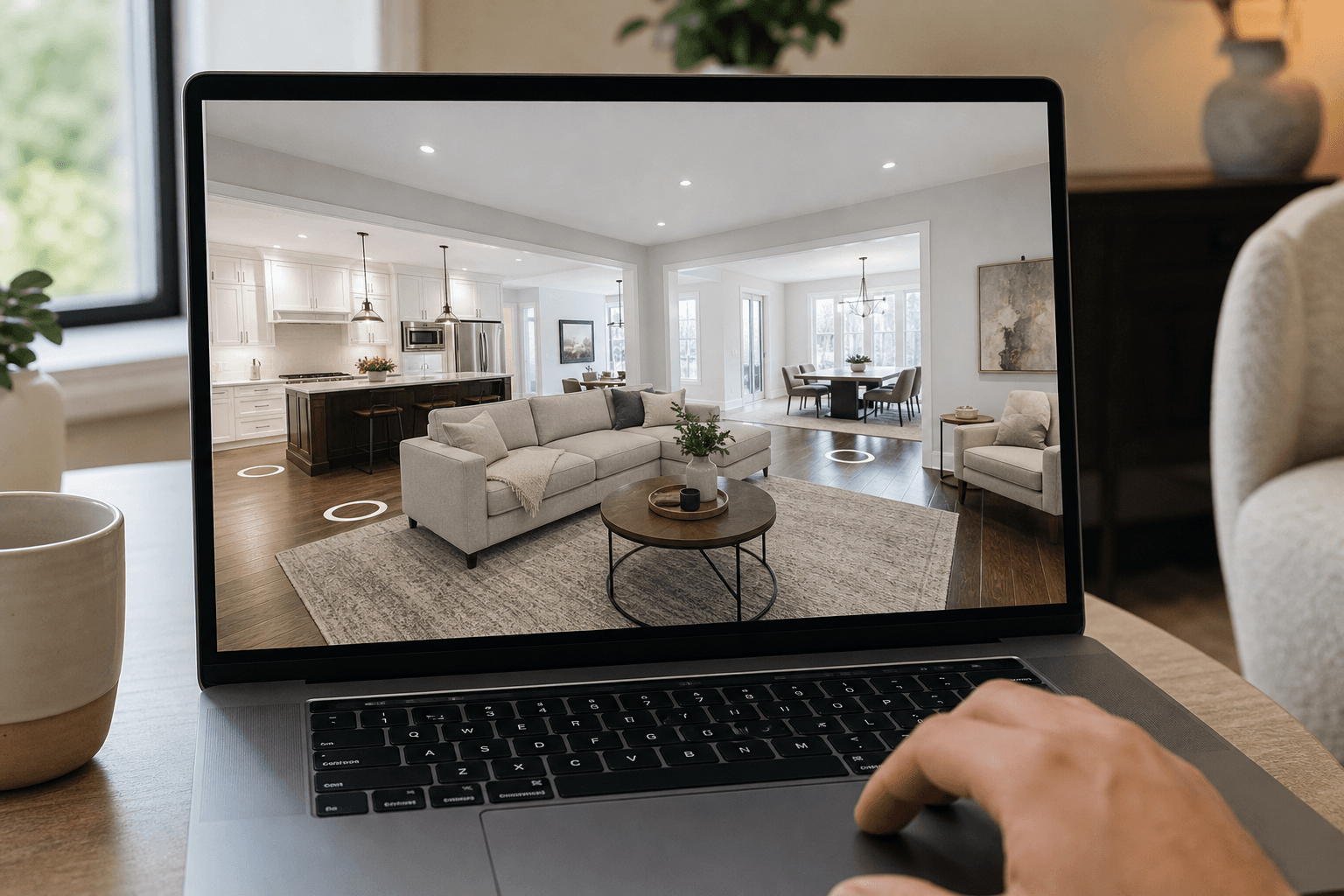
Learn how 3D virtual tours help real estate sellers, buyers, and investors assess layout, screen properties remotely, and plan better showings.
A 3D virtual tour is most worthwhile when people need to understand a property's layout remotely or decide whether an in-person showing is worth their time. Unlike a sequence of photographs, an interactive tour lets viewers move through connected spaces and form a clearer impression of room flow.
That makes a tour a useful screening and decision tool for Mississauga and GTA listings, particularly when buyers are busy, traveling, relocating, or comparing several homes. It is not a substitute for accurate property information, document review, inspection, measurements, or an in-person visit when those steps are needed.
Quick summary

- The strongest 3D virtual tour benefits are better layout comprehension, remote access, and more efficient showing decisions.
- Sellers can give prospective viewers more context before a showing, but a tour does not guarantee more inquiries, a faster sale, or a higher price.
- Buyers and investors can use tours to narrow options and prepare better questions, not to confirm property condition.
- Photography, video, accurate listing information, and in-person verification each provide different information and work best together.
- A tour is most useful when the property's layout, size, or remote audience makes visual exploration especially important.
What a 3D virtual tour helps you understand
A 3D virtual tour creates an interactive representation of a property that viewers can explore from room to room. They may be able to change direction, move through the floor plan, and inspect the relationship between spaces rather than seeing each room as an isolated image.
This can make practical questions easier to consider: Does the entry lead naturally into the main living area? Is the kitchen connected to the dining space? How does the bedroom area relate to the living space? Is the layout likely to suit a household's routines, furniture, or intended use?
The format differs from watching a guided video. A video follows the path selected by the person filming, while an interactive tour gives the viewer more control over where to look and how long to examine a space. That control is particularly helpful during early property screening.
The main benefits for sellers, buyers, and investors

The value of a 3D tour depends on the reader's decision. A seller may want to make a listing easier to evaluate before arranging showings. A buyer may want to eliminate unsuitable properties quickly. An investor may want to compare layouts and identify follow-up questions before spending time on a visit.
For clients considering homes, condos, or investment opportunities across Mississauga and the GTA, the tour can add useful visual context to a focused property search. It should support the broader process of comparing properties, reviewing verified information, and discussing practical questions with a representative.
Benefits for sellers
Help viewers screen the property before a showing
A listing with a 3D tour can help prospective viewers decide whether the property deserves a closer look. Someone who needs a particular bedroom arrangement, an open connection between living areas, or a manageable layout may be able to identify a likely fit before booking a visit.
This can make showing conversations more focused. It may also reduce avoidable appointments with people whose requirements clearly do not match the property, although the effect will vary by listing, audience, and the quality of the information provided.
Make remote interest more practical
Relocating buyers, out-of-town purchasers, and people with demanding schedules may not be able to visit every property immediately. A tour gives them a way to explore the interior before deciding which homes deserve travel time or a live video conversation.
Remote access does not remove the need for local verification. It simply helps a viewer make a more informed first decision when an immediate visit is difficult.
Provide more context than a single image can show
Still photography is essential for presenting finishes, light, views, and standout features. A 3D tour adds another layer by showing how those rooms connect. Together, the formats can help viewers understand both the character of individual spaces and the overall arrangement.
The responsible claim is that a tour can improve convenience and understanding. It should not be presented as proof that a home will attract more inquiries, sell faster, or command a higher price. Those outcomes depend on factors including pricing, condition, location, competition, presentation, and buyer demand.
Benefits for buyers and investors
Compare layout and room flow more efficiently
When several homes or condos appear similar in photographs, layout may become the deciding factor. A tour can help a buyer compare how spaces connect, whether rooms feel separate or continuous, and whether the arrangement supports the intended household or investment use.
For an investor, the tour may help organize an initial comparison of unit configuration, usable spaces, and questions about furnishing or tenant suitability. It cannot establish rental income, operating costs, building rules, or a successful exit strategy.
Reduce unnecessary travel and appointments
A virtual tour can help a buyer remove clearly unsuitable options before arranging a showing. This is useful when someone is reviewing many listings, coordinating multiple decision-makers, or considering properties in different GTA communities.
The goal is not to avoid every in-person visit. It is to reserve visits for properties that remain plausible after an initial review of layout, listing facts, location, and budget.
Prepare better follow-up questions
Viewing a property virtually may reveal questions that are easy to miss in a quick photo review. A buyer might ask about a narrow transition, unusual room shape, storage, ceiling height, window placement, or the relationship between a living area and an entrance.
For an investment decision, visual questions should be combined with a consistent analysis of objectives, full costs, financing assumptions, reserves, risks, and the exit plan.
3D tours compared with photos, video, and in-person visits
These formats are complementary rather than interchangeable. Each answers a different set of questions.
| Format | Best for | Important limitation |
|---|---|---|
| 3D virtual tour | Exploring layout, room connections, and remote screening | May not accurately communicate condition, sound, dimensions, or exterior context |
| Still photography | Showing finishes, light, views, features, and visual presentation | Images select individual angles and may not explain room flow |
| Video tour | Showing movement, sequence, atmosphere, or a guided walkthrough | The viewer generally follows the creator's chosen route and timing |
| In-person visit | Assessing feel, access, noise, condition, surroundings, and practical fit | Requires travel, scheduling, and more time for each property |
Sellers should consider the complete presentation rather than choosing one format in isolation. Professional listing photography remains important for showing finishes, light, and visual details even when an interactive tour is available.
When is a 3D virtual tour worthwhile?
- The property has a complex, unusual, multi-level, or open layout that photographs may not explain clearly.
- The likely audience includes relocating, out-of-town, or international buyers.
- Buyers need to screen several homes before arranging limited showing time.
- The relationship between rooms is important to the property's appeal or practical use.
- The seller wants to provide richer preliminary information before inviting people into the home.
- The property is ready to be represented accurately and consistently across all listing materials.
It may be less important when the property is small and straightforward, the layout is already easy to understand, or the listing has not yet been prepared properly. A tour cannot compensate for unclear facts, weak images, missing documents, poor access instructions, or a pricing strategy that has not been carefully considered.
How a 3D tour fits into a complete listing strategy
An interactive tour should support, not replace, the core information a buyer needs. That includes accurate property facts, a useful description, clear images, location information, pricing context, and showing instructions.
This broader approach is part of effective MLS listing optimization. The purpose is not to promise a particular ranking or transaction result. It is to give viewers consistent information so they can judge whether the property fits their needs.
Before publishing, check that the tour and listing agree on room names, features, inclusions, access, and material details. If the tour shows a space in a way that could be misunderstood, the written listing should provide the necessary clarification.
Limitations: what a 3D tour cannot confirm
A tour can look detailed while still providing limited evidence about the property's actual condition. It may not show small defects, uneven surfaces, odors, drafts, sound transmission, appliance performance, or the difference between a fresh finish and a durable one.
Virtual perspective can also affect a viewer's sense of size. Camera position, stitching, lighting, lens behavior, and the viewer's screen may make a room feel larger or smaller than it is. Buyers should use stated measurements and appropriate documents, then verify important dimensions themselves.
Exterior context may be incomplete as well. A tour cannot necessarily communicate traffic noise, nearby construction, sunlight at different times, parking realities, access routes, or the condition of shared spaces. Those questions call for local research, direct observation, professional advice, or document review as appropriate.
Seller checklist before adding a 3D tour
- Prepare the rooms: Remove unnecessary clutter and make the intended use of each space easy to understand.
- Protect privacy: Put away documents, valuables, personal photographs, and items that should not appear publicly.
- Confirm accuracy: Check room labels, features, inclusions, exclusions, and material property details against the listing.
- Plan access: Make sure the property can be captured safely and that occupants, pets, and scheduled activities are considered.
- Keep formats consistent: Ensure the tour, photographs, written description, pricing information, and showing instructions do not conflict.
- Consider accessibility: Provide clear written information for people who cannot or prefer not to use an interactive tour.
- Review the final version: Check for inaccurate views, private information, confusing labels, and areas that need explanation before publication.
A simple decision framework
Use a 3D tour now when layout understanding and remote screening are central to the property's audience or appeal, and the home is ready to be represented accurately.
Consider one when the property has useful spatial detail but the likely audience and expected showing volume are uncertain. Weigh the tour alongside photography, video, listing quality, and the seller's priorities.
Wait or skip it for now when the property is not ready, sensitive information cannot be protected, or basic facts and presentation still need attention.
Frequently asked questions
Can a 3D virtual tour replace an in-person home showing?
No. It can help someone decide whether a showing is worthwhile, but it cannot fully communicate condition, sound, scale, surroundings, or the experience of being in the property.
Are 3D virtual tours more useful for condos and complex layouts?
They can be particularly useful when a unit's layout, transitions, or relationship between rooms is difficult to understand from photographs. They may also help buyers compare several units efficiently.
Do 3D virtual tours guarantee a faster sale or higher offer?
No. A tour may improve convenience and help suitable viewers screen the property, but it cannot guarantee a sale speed, number of inquiries, offer amount, or final price.
What should buyers still verify after viewing a property virtually?
Verify measurements, condition, defects, inclusions, exclusions, taxes, fees, documents, building or community rules, access, noise, surroundings, and any issue relevant to your decision.
Should a seller use a 3D tour with photography and video?
Often, the formats serve different purposes. Photography can show finishes and visual details, video can guide a viewer through a sequence, and a 3D tour can support independent layout exploration.
Conclusion: Use the tour to improve understanding, not replace judgment
The clearest 3D virtual tour benefits are practical: viewers can explore a property remotely, understand room flow more easily, compare options, and decide whether to arrange a showing. Sellers can use that additional context to make early evaluation more informative, particularly for busy or distant buyers.
The format is not a guarantee of stronger offers or a faster transaction. Its value depends on accurate listing information, appropriate preparation, clear photography, sensible pricing context, and the buyer's willingness to verify important details.
For guidance on property marketing, buying, selling, or investment decisions in Mississauga and the GTA, discuss your goals and property needs with Qasim Khan Real Estate.
Written by
Qasim Khan
Real Estate Professional, QASIM KHAN Real Estate